
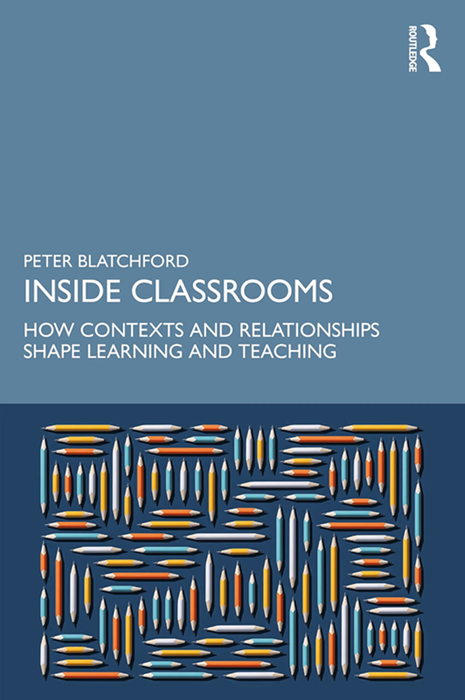
Peter Blatchford's
Inside Classrooms
How Contexts and Relationships Shape Learning and Teaching
2026
London; Routledge
eBook ISBN9781003736943
Abstract
This compelling book explores the dynamics of learning in school classrooms, drawing on over 30 years of large-scale educational research. Through extensive, naturalistic, and systematic observations of pupils and teachers, it challenges traditional explanations for learning differences, arguing that factors like motivation, sociological influences, parental involvement and teacher effectiveness are insufficient because they overlook the immediate contextual and interactive processes that directly shape learning outcomes.
The book introduces a new eco-relational approach with three key dimensions. The first focuses on the immediate classroom context, including factors such as the layout, group organisation, and the types of tasks and interactional settings. The second examines the interactions and relationships within the classroom, both between teachers and students and among students themselves. The third dimension explores how these contextual and relational elements align—or fail to align—within the interconnected and dynamic classroom system. Organised into three sections, the book begins with an in-depth review of educational and psychological research and theory to show the importance of context in human development. The second section applies the eco-relational framework to findings from three of the author’s research programmes, covering class size effects, group organisation and group work, and the inclusion of pupils with SEND in mainstream schools. The final section outlines the eco-relational foundation for the SPRinG project, a unique programme designed to support collaborative group work in schools.
Inside Classrooms is an integration of research that offers a new approach to thinking about factors influencing learning. It is meant for academics and researchers but also teachers and school leaders, those involved in initial teacher training and professional development of teachers, policy makers and commentators, teacher representatives, and parents.
Author: Peter Blatchford (2027). ‘Inside Classrooms: How Contexts and Relationships Shape Learning and Teaching’ Routledge
This compelling book explores the dynamics of learning in school classrooms, drawing on over 30 years of large-scale educational research. Through extensive, naturalistic, and systematic observations of pupils and teachers, it challenges traditional explanations for learning differences, arguing that factors like motivation, sociological influences, parental involvement and teacher effectiveness are insufficient because they overlook the immediate contextual and interactive processes that directly shape learning outcomes.
The book introduces a new eco-relational approach with three key dimensions. The first focuses on the immediate classroom context, including factors such as the layout, group organisation, and the types of tasks and interactional settings. The second examines the interactions and relationships within the classroom, both between teachers and students and among students themselves. The third dimension explores how these contextual and relational elements align—or fail to align—within the interconnected and dynamic classroom system.
Organised into three sections, the book begins with an in-depth review of educational and psychological research and theory to show the importance of context in human development. The second section applies the eco-relational framework to findings from three of the author’s research programmes, covering class size effects, group organisation and group work, and the inclusion of pupils with SEND in mainstream schools. The final section outlines the eco-relational foundation for the SPRinG project, a unique programme designed to support collaborative group work in schools.
Inside Classrooms is an integration of research that offers a new approach to thinking about factors influencing learning. It is meant for academics and researchers but also teachers and school leaders, those involved in initial teacher training and professional development of teachers, policy makers and commentators, teacher representatives, and parents.
Peter Blatchford is Emeritus Professor in Psychology and Education at the UCL Institute of Education, UK. His research interest is better understanding social and developmental processes in classroom settings. He directed large-scale research programmes on class size effects, the impact of support staff, grouping practices and collaborative group work, and the education of pupils with SEND in mainstream schools.
Blatchford, P. (2027) (but published October 2026) ‘Inside Classrooms: How Contexts and Relationships Shape Learning and Teaching’ Routledge
Here are some commendations for the book:
Context matters! Building on extensive research, Peter Blatchford’s Inside Classrooms… offers us gap-filling explanations beyond instructional methods and learner characteristics. The corresponding classroom-level strategies of his eco-relational approach to support learning identify universal factors making it internationally relevant. A must read for everyone who cares about authentic student learning. Michael F. Giangreco, PhD, University Distinguished Professor Emeritus of Special Education, University of Vermont
Class size, classroom groupings, collaborative learning, SEND pupils. In this timely and accessible volume, Peter Blatchford’s eco-relational lens integrates his 30+ years of research across these crucial topics. The result – a masterful agenda for policy, practice and research. Christine Howe, Emeritus Professor of Education, University of Cambridge
Blatchford’s important book gives a richly textured picture of teaching and learning in the complex micro physical and social context of the classroom. Crucially, it shows how contextual features — class size, layout, grouping, tasks and interactional settings —are interconnected with relationships and interactions among teachers and students.
Noreen M. Webb, Distinguished Research Professor, University of California, Los Angeles
In this wonderfully argued and important book, Blatchford presents a strong case for his eco-relational framework as a way of improving teaching and learning. He skilfully shows how the classroom context along with the teacher-student and peer-peer relationships contribute strongly to student learning. Christine Rubie-Davies, Emeritus Professor, University of Auckland
This is an impressive body of work… drawing on a lifetime of research by Peter Blatchford… it is substantial, rigorous, and deeply insightful….Much existing research operates at too great a distance from the learner, privileging distal explanations over the proximal processes through which learning actually occurs. In contrast, this work insists on…understanding the lived, moment-by-moment complexity of classrooms as a prerequisite for meaningful improvement. John Hattie, Melbourne Laureate Professor Emeritus, University of Melbourne